

-
By test
-
February 7, 2024
- 0 Comment
The Role of Catalysts in Industrial Processes
Catalysts are substances that accelerate chemical reactions without consuming themselves in the process. From petroleum refining and pharmaceutical synthesis to polymer production and food processing, they are foundational to modern industry. Because high-performance catalysts, including precious metals such as platinum, palladium, and rhodium, can be extraordinarily costly, recovering and reusing them isn’t just good practice; it’s essential to process economics.
Even catalyst materials that aren’t composed of precious metals represent a significant operational investment. Loss through process streams, whether liquid or gas, directly erodes margins and can create downstream contamination problems.a
"Catalyst losses that seem trivial at the bench scale translate into tens of thousands of dollars annually at production volume. Effective recovery filtration is one of the highest-return investments a plant can make."
What Is a Catalyst Recovery Filter?
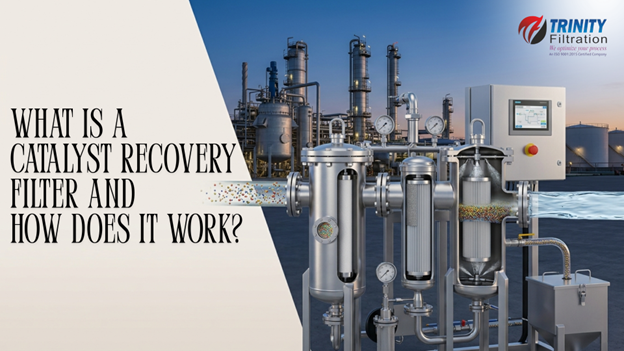
A catalyst recovery filter is a specialized filtration device designed to capture catalyst particles, solid-phase catalysts, catalyst fines, or catalyst carriers from a fluid stream before that stream exits the reaction system. The filter prevents valuable material from being lost to waste streams, protects downstream equipment from fouling or damage, and helps maintain product purity.
Unlike general-purpose process filters, catalyst recovery filters are engineered with several priorities in mind: extremely high capture efficiency for fine particles (often in the sub-micron range), chemical compatibility with aggressive process fluids, and minimal catalyst damage during collection and recovery cycles.
Common Applications by Industry
- Petroleum Refining — Recovery of fluid catalytic cracking (FCC) catalysts and hydroprocessing catalysts from reactor effluents.
- Pharmaceutical Synthesis — Removal and recovery of palladium and other precious-metal catalysts from API manufacturing streams.
- Polymer Production — Capture of Ziegler-Natta and metallocene catalyst residues from polyolefin process streams.
- Fine Chemicals — Recovery of zeolites, alumina-supported catalysts, and activated carbon from batch and continuous reactions.
How Catalyst Recovery Filters Work
The operating principle varies by filter type and application, but the fundamental mechanism is consistent: the process stream passes through a filter medium whose pore structure or surface chemistry captures suspended catalyst particles while allowing the fluid carrier to pass through.
Step 1: Stream Entry & Pre-conditioning
The catalyst-laden fluid enters the filter housing. In high-solids-loading applications, a pre-filter stage may be used to protect the primary recovery filter and extend service intervals.
Step 2: Particle Capture
As the fluid passes through the filter medium, catalyst particles are captured via surface straining (particles larger than the pore), depth filtration (particles trapped within the media matrix), or cake filtration (a growing layer of catalyst on the filter surface).
Step 3: Clean Filtrate Exit
The clarified process fluid exits the filter, continuing downstream essentially free of catalyst. Depending on application requirements, effluent quality can be controlled to parts-per-million or sub-ppm levels.
Step 4: Recovery & Regeneration
When differential pressure across the filter reaches a set point, the unit is taken offline, and the collected catalyst is removed by backflushing, blowback, or physical cleaning for reintroduction to the process or off-site regeneration.
Key Filter Media and Construction Materials
Selecting the right filter medium is critical to both capture efficiency and catalyst integrity. The most common technologies in catalyst recovery services include the following:
Sintered Metal Filters
Sintered stainless steel and sintered titanium elements offer exceptional mechanical strength, high-temperature tolerance, and chemical resistance. They are well suited to rigorous regeneration cycles, including steam, caustic, and solvent cleaning, and can achieve sub-micron ratings when required.
Candle Filters
Candle-style filter elements provide a large surface area in a compact housing. They are often used to recover catalysts in fixed-bed and slurry-phase processes, especially when the catalyst creates a filterable layer that can be easily cleaned and reused.
Pleated Membrane Elements
For applications demanding the highest particle removal efficiency, such as precious metal recovery in pharmaceutical manufacturing, pleated membrane cartridges offer tight, absolute-rated pore structures in materials ranging from PTFE and polypropylene to hydrophilic PVDF.
Superior Efficiency Housing for Catalyst Recovery
Trinity’s filter housings for catalyst recovery are engineered for chemical process service: all-welded 316L stainless steel construction, electropolished internal surfaces to minimize catalyst adhesion, and modular designs that accommodate candle, bag, and cartridge elements. Our engineering team can help size and configure a system matched to your specific catalyst type, particle size distribution, and operating conditions.
Design Considerations for Effective Catalyst Recovery
Particle Size Distribution
Catalyst fine particles well below 10 microns are the most challenging to capture and the most damaging when lost. Filter selection must be based on the actual particle size distribution of the The catalyst in its process-aged state, not just the fresh catalyst specification, is important because attrition during the reaction can generate significantly finer material over time.
Operating Conditions
Temperature, pressure, and chemical environment all constrain media selection. High-temperature applications may require metallic or ceramic filter media. Highly acidic or caustic streams rule out many polymeric materials. Oxidizing environments demand careful alloy selection for metallic components.
Batch vs. Continuous Operation
Batch processes often tolerate filter changeouts during scheduled downtime, while continuous processes require duplex (parallel) filter installations with automatic or manual switching capability to maintain uninterrupted production during filter servicing.
Catalyst Fragility
Aggressive backflushing can damage some catalysts, particularly shaped pellets and fragile extrudates. Recovery procedures need to be created to reduce the wear on particles so that the recovered catalyst stays effective and can be reused directly.
Custom-Engineered Recovery Systems
Trinity creates and builds custom recovery systems tailored to your process, ranging from duplex housing assemblies with automatic pressure switching to fully assembled catalyst recovery units, rather than using generic solutions. Our ASME-coded vessels and industry-standard connections integrate cleanly into new construction and retrofit projects alike.
Economic and Environmental Benefits
The business case for investing in high-quality filtration for catalyst recovery is compelling. The direct cost of catalyst makeup replacing materials lost in process streams is typically many times the annualized cost of the filtration system that prevents that loss. In precious-metal catalyst service, a single percentage point improvement in recovery efficiency can represent hundreds of thousands of dollars per year at scale.
Beyond direct cost savings, effective catalyst containment reduces the environmental burden associated with catalyst disposal, minimizes the risk of contaminating product streams, and protects heat exchangers, pumps, and downstream reactors from erosion and fouling caused by catalyst fines.
Choosing the Right Recovery Filter Partner
Catalyst recovery is a technically demanding application where the consequences of underperformance in terms of both economics and product quality are significant. The right filter supplier brings not just hardware but application knowledge: an understanding of catalyst behavior, familiarity with filtration mechanisms, and the engineering capability to design a system that performs reliably across the full range of your operating conditions.
At Trinity Filtration Technologies, we have built our product line and engineering practice around exactly these requirements. Whether you’re evaluating options for a new facility or troubleshooting losses in an existing process, we welcome the opportunity to work through the problem with you.
Questions about catalyst recovery for your specific process? Contact the Trinity Filtration Technologies engineering team for a consultation.