
Pharmaceuticals & Biotech
Purity and Compliance in Every Process
Pharmaceutical manufacturing demands a high level of control over particulate contamination, microorganisms and process impurities at every critical stage.
From raw materials and solvents to biological fluids and final drug products, filtration plays an important role in maintaining process consistency and supporting the required quality of pharmaceutical products.
Trinity Filtration Technologies provides filtration solutions for pharmaceutical manufacturing applications, including prefiltration, solvent and gas filtration, API processing, biological fluids, oral drugs, vaccines and ophthalmic solutions.
Our filtration solutions can be applied across different stages of pharmaceutical and bioprocess manufacturing, from upstream process protection to final sterile filtration.
Pharmaceutical Filtration Applications
Pharmaceutical processes involve a wide range of fluids, chemicals, gases and biological materials. Each application requires filtration technology selected according to the fluid characteristics, contaminant load, required filtration level and process conditions.
Trinity provides filtration solutions for:
- Pre-filtration
- Solvent filtration
- Gas and air filtration
- API solvents
- Biological fluids
- Oral drug formulations
- Vaccines
- Ophthalmic solutions
The reference catalogue similarly identifies filtration applications across biological processing, sterile pharmaceutical/API/biological products, chemicals and solvents, and air and gas systems.
Pre-Filtration & Clarification
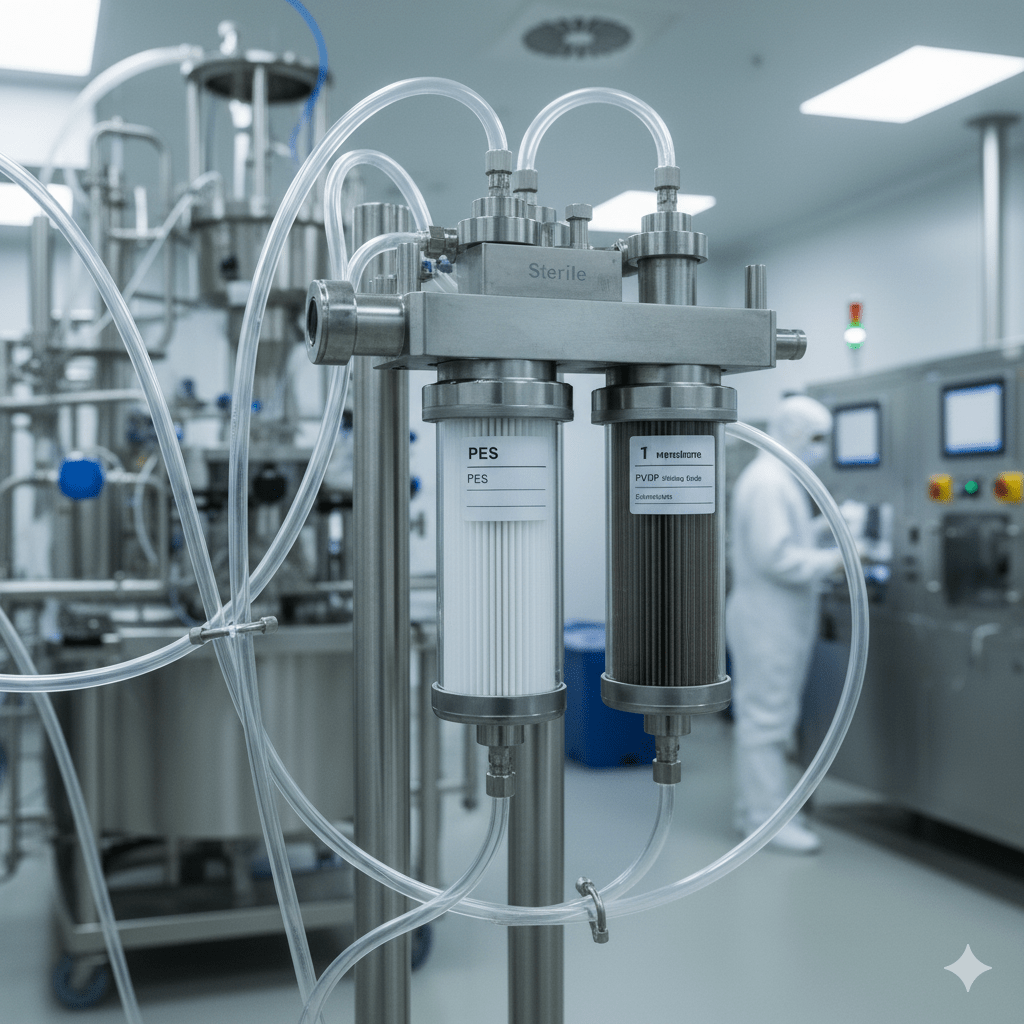
Prefiltration is an important step for protecting downstream filtration systems from excessive contaminant loading.
Pharmaceutical and biological process fluids may contain particulates, colloidal material, cell debris or other contaminants that can reduce the service life of downstream membrane filters.
The reference material describes prefiltration and clarification as methods for removing bulk contaminants and protecting downstream sterile membranes.
Trinity filtration solutions can be considered for:
- Raw material filtration
- Process-fluid clarification
- Biological fluid prefiltration
- Solvent prefiltration
- Protection of final membrane filters
- Reduction of particulate loading
Benefits
Protect downstream filters
Reduce the contaminant load reaching final filtration stages.
Improve filter life
Appropriate prefiltration can help extend downstream membrane service life.
Improve process consistency
Control particulate contamination before subsequent processing steps.
Solvent Filtration
Solvents are widely used in pharmaceutical manufacturing, including extraction, processing and formulation applications.
Pharmaceutical manufacturing can involve solvents with different chemical characteristics, making chemical compatibility and appropriate membrane selection important considerations.
The reference catalogue specifically identifies alcohol, acetone, methylene chloride and other aggressive materials as examples of chemicals and solvents used in biological manufacturing.
Applications include:
- API solvent filtration
- Process solvent filtration
- Extraction solvent filtration
- Solvent prefiltration
- Final solvent filtration
- Bulk pharmaceutical chemical filtration
For low-viscosity solvent applications, the source material also describes pleated polypropylene filtration as suitable for solvent and water filtration because of its surface area, flow capacity and chemical compatibility.
API Solvent Filtration
Active Pharmaceutical Ingredient (API) manufacturing requires controlled processing conditions and effective contamination management.
Filtration of API-related solvents and process streams can help control particulate contamination before the material moves to subsequent processing stages.
API filtration applications can include:
- API solvent filtration
- Process chemical filtration
- Intermediate filtration
- Prefiltration
- Final filtration
- Bulk pharmaceutical chemical filtration
The pharmaceutical catalogue specifically includes sterile filtration of pharmaceutical and API products and bulk pharmaceutical chemical filtration among its applications.
Air & Gas Filtration
Air and process gases can become a potential source of contamination in pharmaceutical and bioprocess manufacturing.
Gas filtration applications may include:
- Process air
- Nitrogen
- Tank venting
- Sterile air
- Gas used for tank-to-tank transfer
- Aseptic processing environments
- Fermentation inlet and exhaust gases
The reference catalogue notes that gases coming into contact with product in sterile manufacturing processes are sterile filtered, including nitrogen used for purging or blanketing.
Hydrophobic PTFE membrane filters are described in the catalogue for applications involving air and gas streams, including process tank venting, aseptic filling lines, autoclave vents and fermentation air.
Biological Fluid Filtration
Biological fluids can present complex filtration challenges because they may contain cells, cell debris, proteins, colloids and other process-related contaminants.
Filtration may be used for clarification, prefiltration, membrane protection and sterile filtration depending on the process stage.
The reference catalogue describes clarification of biological fluids such as cell-culture harvest fluids, fermentation broths, serum and media feeds.
Applications include:
- Cell culture fluids
- Biological process fluids
- Serum and blood fractions
- Fermentation fluids
- Protein-containing streams
- Biological intermediates
The catalogue identifies BioLIFE-type filtration specifically for clarification of biological fluids and protection of downstream membranes.
Oral Drug Filtration
Oral pharmaceutical formulations require appropriate contamination control while maintaining the characteristics of the formulation.
Filtration can be incorporated into suitable process stages to remove unwanted particulate contamination and support product quality.
Applications include:
- Oral liquid formulations
- Oral pharmaceutical solutions
- Process intermediates
- Syrup and liquid drug formulations
- Final product filtration
The reference catalogue lists orals and topicals among applications for sterilizing-grade membrane filtration.
Vaccine Filtration
Vaccine manufacturing involves highly sensitive biological materials and requires careful control of contamination throughout the process.
Filtration can be used at different stages depending on the vaccine process, including prefiltration, clarification, biological-fluid processing and sterile filtration.
The pharmaceutical catalogue identifies vaccines among the applications for membrane filtration systems.
Potential applications include:
- Vaccine process-fluid filtration
- Biological fluid clarification
- Prefiltration
- Sterile filtration
- Process air and gas filtration
- Final product filtration
The exact filtration configuration should be selected based on the vaccine formulation, process conditions and required validation criteria.
Ophthalmic Solution Filtration
Ophthalmic products require particularly careful contamination control because the final formulation is intended for application to the eye.
Filtration can be incorporated into ophthalmic manufacturing processes for:
- Ophthalmic solutions
- Sterile aqueous formulations
- Process fluids
- Final sterile filtration
- Prefiltration and membrane protection
The reference catalogue specifically identifies ophthalmics among applications for its sterilizing-grade membrane filtration technology.
Sterile Filtration for Pharmaceutical Products
For sterile pharmaceutical products, final filtration is a critical process step before filling.
The reference catalogue describes sterilizing-grade membrane cartridges being used immediately before filling operations to provide a sterile fluid stream. It also describes prefilters being used to protect downstream sterile filters from contaminant loading.
Applications include:
- Parenteral products
- API solutions
- Biological products
- Ophthalmic solutions
- Vaccines
- Oral liquid formulations
- Pharmaceutical process fluids
A filtration system should be selected according to the specific product, process conditions, microbial retention requirements, compatibility and validation requirements.
A Multi-Stage Approach to Pharmaceutical Filtration
A pharmaceutical filtration system should not always rely on a single filter.
A typical process may incorporate:
Raw Material / Process Stream
↓
Coarse Prefiltration
↓
Fine Prefiltration
↓
Clarification
↓
Membrane Protection
↓
Sterile Filtration
↓
Holding / Storage
↓
Filling
This staged approach allows the filtration system to manage different contaminant loads at different points in the process.
For example, the catalogue’s chemical/solvent application shows a progression from coarse prefiltration and fine prefiltration to membrane prefiltration and final sterile filtration.
Why Choose the Right Pharmaceutical Filtration System?
The right filtration system can help pharmaceutical manufacturers address several process requirements:
- Contamination Control
Remove or control unwanted particulate and microbiological contamination according to the application.
- Downstream Filter Protection
Prefiltration can reduce contaminant loading on final membrane filters.
- Process Reliability
Consistent filtration can help maintain stable process conditions.
- Product Quality
Appropriate filtration supports the control of contaminants throughout the manufacturing process.
- Sterile Processing
Sterilizing-grade filtration can be incorporated into suitable pharmaceutical and biological applications.
- Process Flexibility
Different filter technologies can be selected according to the characteristics of the product and process.
Frequently Asked Questions
Our filters are developed from high-grade raw materials such as 316L stainless steel, PTFE, and specialized sintered metals. These materials offer extraordinary resistance to reactive solvents and high temperatures, ensuring safe and consistent operations.
We recommend our pleated depth filter cartridges and high-grade stainless steel vent filters. These are specifically designed to prevent contamination from entering systems while protecting the environment from aerosols.
Yes, our advanced filtration units are engineered to work efficiently with high-viscosity grades (up to 420 CST), maintaining superior performance in demanding applications.
Frequency depends on the specific application, contamination load, and reaching established differential pressure limits rather than time alone.
Implementing prefiltration (using dual-layer models or targeted pre-filters) to handle the bulk of the particle load can significantly reduce changeouts and overall costs.
Understanding the volume of contamination generated, required flow rates, and tolerable pressure drops is critical for correct sizing.
We are always ready to help you and answer your questions