
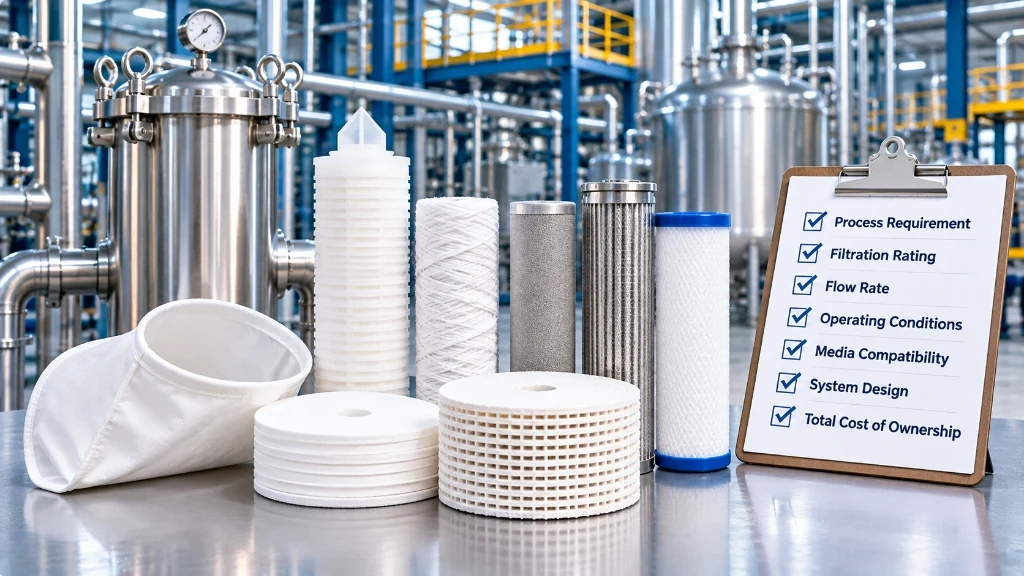
Executive Summary & Key Takeaways
- Whether managing a chemical plant, food processing facility, or pharmaceutical laboratory, contaminants in process fluids cause equipment failure, compromised product quality, and costly downtime.
- Choosing the right industrial filtration system requires evaluating contaminant particle size distribution (PSD), peak flow rate, fluid viscosity, temperature, chemical compatibility, and nominal vs. absolute micron ratings.
- A custom three-stage filtration approach (Pre-Filtration, Main Filtration, and Post-Filtration) lowers Total Cost of Ownership (TCO) and maximizes plant uptime.
In the high-stakes world of industrial manufacturing, purity is not just a preference—it is a requirement. Whether you are managing a chemical plant, a food processing facility, or a pharmaceutical laboratory, the presence of contaminants in your process fluids can lead to catastrophic equipment failure, compromised product quality, and expensive downtime.
However, selecting the right industrial filtration system is rarely a "one-size-fits-all" decision. With a vast array of technologies available, from simple bag filters to complex multi-stage setups, making an uninformed choice can be a costly mistake. For plant managers and process engineers, the goal is to find a balance between high-efficiency industrial filtration solutions and operational cost-effectiveness.
This guide explores the technical nuances of choosing the ideal process filtration system and how the right industrial filtration equipment can transform your production efficiency through properly engineered liquid filtration systems.
Why Industrial Filtration Matters
Implementing a robust industrial filtration system is a strategic investment in the longevity of your facility. Beyond simply "cleaning" a fluid, filtration serves several core business functions.
Equipment Protection
Downstream components like high-pressure pumps, spray nozzles, and heat exchangers are highly sensitive to particulate matter. Without a proper industrial filter system for manufacturing, abrasive particles can cause erosion, clogging, and mechanical seal failure. By installing a high-quality industrial filtration system, you extend the Mean Time Between Failures (MTBF) for your most expensive assets.
Product Quality
In sectors like the chemical industry or beverage production, even microscopic contaminants can result in an entire batch being rejected. Consistent process filtration solutions ensure that your end product meets the rigorous quality benchmarks expected by your clients and end-users.
Process Efficiency
A well-designed filtration setup maintains optimal flow rates and reduces the frequency of maintenance shutdowns. When you minimize the pressure drop across your system, you reduce energy consumption and maximize throughput. Liquid filtration systems that are correctly sized allow for longer run times and fewer interruptions.
Regulatory Compliance
Environmental and safety regulations, such as those from the EPA or FDA, require strict adherence to fluid purity standards. Effective filtration helps in meeting discharge standards and ensures that process fluids are safe for both the workforce and the environment.
Key Factors to Consider When Choosing an Industrial Filtration System
To determine how to choose filtration system components that actually work for your specific application, you must evaluate several technical variables.
1. Contaminant Type and Particle Size
The first step is a thorough analysis of the "dirt" you are trying to remove. Are the contaminants rigid, deformable, or organic? Understanding the particle size distribution (PSD) allows you to select a micron rating that captures the harmful particles without clogging prematurely. For example, rigid sand particles are handled differently than soft, gelatinous organisms.
2. Flow Rate Requirements
Your industrial filtration equipment must handle the maximum flow rate of your process without causing a significant bottleneck. It is essential to size the housing and the media to accommodate peak flows while maintaining a low "clean pressure drop." If the flow velocity is too high, it can force contaminants through the media, compromising the integrity of the process filtration system.
3. Fluid Properties
The "chemistry" of your process dictates the material of your filter. Consider these three factors:
- Viscosity: Thicker fluids (like resins or heavy oils) require more pressure or larger surface areas to pass through a filter media.
- Temperature: High-temperature processes require specialized metallic or high-grade polymer housings to prevent thermal degradation.
- Chemical Compatibility: You must ensure the filter media and seals (O-rings) don't degrade when exposed to aggressive solvents or acids.
4. Filtration Efficiency and Micron Rating
The micron rating indicates the size of particles the filter can trap. However, it is vital to distinguish between nominal (roughly 60–80% efficiency) and absolute (99.9% efficiency) ratings. Using an absolute-rated filter for a pre-filtration stage is often an unnecessary expense, while using a nominal filter for final polishing can lead to quality failures in your liquid filtration systems.
5. Maintenance and Filter Life
How often can you afford to change the filter? Industrial filtration solutions with a high dirt-holding capacity, such as Trinity’s pleated cartridges, reduce the "Total Cost of Ownership" (TCO) by extending the intervals between service interruptions.
Types of Industrial Filtration Systems
At Trinity Filtration Technologies, we provide a diverse range of hardware designed to meet specific engineering challenges. Our products are engineered to provide maximum efficiency with minimal maintenance.
Cartridge Filter
Cartridge filters are ideal for applications requiring high purity and fine filtration. Trinity’s range includes depth cartridges like the Trinity Melt Blown Series for high dirt loading and pleated cartridges like the Trinity Pleatmaster for high surface area. These are often the preferred industrial filtration systems for pharmaceutical and electronics manufacturing.
Bag Filter
For high-flow applications with larger particulate loads, a bag filter system is often the most cost-effective choice. The Trinity Sentinel Bag Filter Housings are designed for easy change-outs and are widely used in wastewater treatment and the paint/coating industry.
Multi-Stage Filter
In complex processes, a single filter is rarely enough. Multi-stage filtration combines different media types—such as a coarse bag filter followed by a fine cartridge filter—to progressively remove contaminants. This protects the expensive final-stage filters from premature fouling and is a hallmark of high-performing industrial filtration systems.
Activated Carbon Filter
To remove odors, colors, or dissolved organic chemicals, an activated carbon filter is essential. These are critical filtration systems for chemical industry applications and water purification stages to ensure the fluid is chemically "pure" rather than just physically clean.
Membrane Filter
When your process requires sub-micron filtration or sterile results, membrane filters are the gold standard. Trinity’s PES and PTFE membrane series use a precise pore structure to remove bacteria and viruses, making them a staple in the biotech and beverage sectors.
Common Mistakes When Selecting Filters
Even seasoned engineers can fall into common traps when sourcing industrial filtration equipment:
- Wrong Micron Rating: Selecting an overly fine filter increases pressure drop and replacement frequency without adding functional value.
- Ignoring Pressure Drop: Not accounting for the "Delta P" can lead to a system that hits its terminal pressure almost immediately, halting production.
- Choosing Based on Price Only: A cheaper filter often has a lower dirt-holding capacity, meaning you spend more on labor and replacements in the long run.
- Incompatible Materials: Using a standard seal in a solvent-heavy process can cause the seal to swell and leak, leading to contamination bypass in your liquid filtration systems.
How Custom Filtration Solutions Improve Process Efficiency
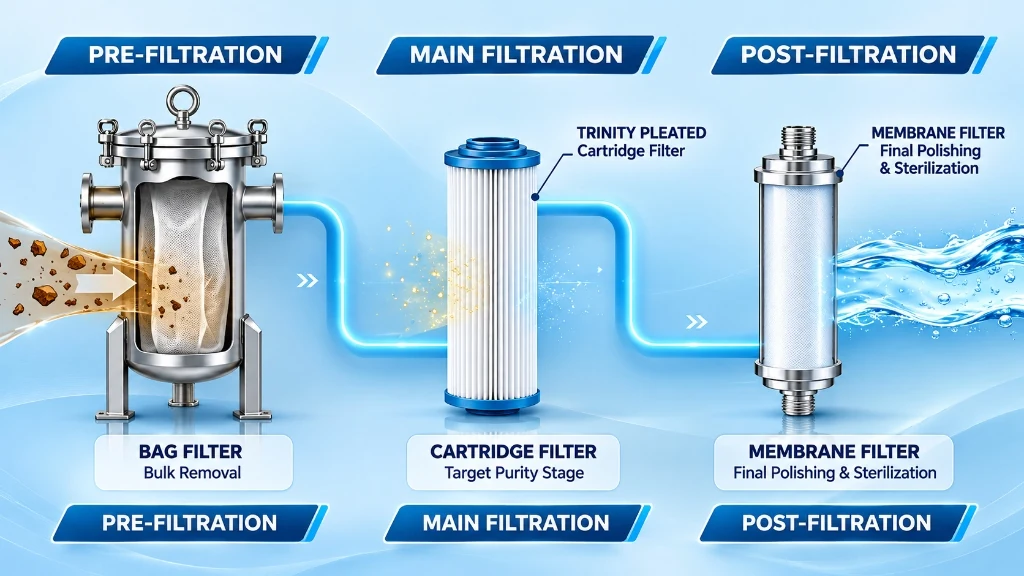
Standard, off-the-shelf filters often fail to meet the specific demands of a unique industrial process. This is where custom filtration solutions from Trinity Filtration Technologies provide a competitive edge. We view filtration as a three-stage journey:
1. Pre-Filtration
This is the "heavy lifting" stage. By using robust Trinity Bag Filters or coarse depth cartridges, we remove the bulk of the contaminants. This protects the more expensive downstream equipment and ensures the main filtration stage can function at peak efficiency.
2. Main Filtration
This is where the target purity is achieved. Whether it’s using Trinity High-Flow Cartridges for large volumes or specialized pleated media, this stage is tailored to the exact micron requirement of your process. This is the core of most liquid filtration systems.
3. Post-Filtration
The final "polishing" or sterilization stage. Using Trinity Membrane Filters or activated carbon, we ensure that the fluid leaving the system is of the highest possible quality, free from even the smallest traces of impurities or odors.
Tailored process filtration solutions perform better because they are engineered for your specific flow rates and contaminant profiles. Trinity Filtration Technologies naturally integrates these stages into a seamless, high-performance skid or housing assembly that minimizes waste and maximizes uptime.
Conclusion
Choosing the right industrial filtration system is a balance of science, engineering, and strategic procurement. By understanding your contaminant profile, flow requirements, and fluid chemistry, you can select industrial filtration solutions that do more than just clean a fluid—they optimize your entire production line.
From protecting expensive machinery to ensuring regulatory compliance, the right process filtration system is the heartbeat of a successful manufacturing operation. High-performance liquid filtration systems ensure that your plant remains competitive and efficient in a demanding market. Don’t leave your process purity to chance.
Are you ready to optimize your process?
Contact the experts at Trinity Filtration Technologies today for a technical consultation. Our team of engineers will help you design and implement the perfect industrial filtration system tailored to your specific needs.
Request Technical Consultation →Frequently Asked Questions (FAQ)
1. What is the difference between nominal and absolute micron ratings?
A nominal rating refers to the filter's ability to trap a percentage of particles of a certain size (e.g., 80% of 5-micron particles). An absolute rating means the filter captures 99.9% or more of particles at that size, providing a much higher level of precision for critical industrial filtration equipment.
2. How do I know when to change my industrial filter?
The most reliable way is to monitor the pressure drop (differential pressure or Delta P). When the pressure difference between the inlet and outlet reaches a specific threshold (usually 15–25 psi depending on the housing), it indicates the filter is saturated and needs replacement to maintain efficient liquid filtration systems.
3. Can I use the same filter housing for different types of cartridges?
In many cases, yes, provided the housing dimensions (222 or 226 O-rings, DOE, etc.) are compatible. However, it is always best to consult with a provider like Trinity Filtration Technologies to ensure that the flow dynamics and chemical compatibility remain optimal for your industrial filtration system.
4. Why is my filter clogging faster than expected?
This is usually due to an increase in contaminant loading or an incorrect micron rating for the pre-filtration stage. If your initial stage is inadequate, the main filter will "blind" or clog prematurely. A multi-stage industrial filtration system can solve this issue by spreading the load.
5. Are custom filtration solutions more expensive than standard ones?
While the initial investment in a custom process filtration system may be higher, the "Total Cost of Ownership" is typically much lower. Custom liquid filtration systems provide longer filter life, better equipment protection, and reduced downtime, leading to significant long-term savings.